| Pioneer Mothers Memorial Forest offers a 0.8 mile hiking trail through 88 acres of old growth forest. The trail is a short and easy hike, but it is well worth the trip. The trees are enormous and beautiful. Note: Since this area is a
Research Natural Area no hunting, camping, target shooting, or plant
collecting is allowed. Horses and bikes are also prohibited in this
area. This trail operated by: |
For More Information
Contact: |
Some History...
Imagine walking
through Indiana 100 years ago. Instead of cornfields and forested hillsides
of young trees, there were 19,000,000 acres of old growth forests. Walnut
trees 40 inches in diameter and 130 feet tall were common.
Ancient oaks which had stood since before Columbus discovered America
were abundant.
You don't
have to just imagine, you can visit Pioneer Mothers Memorial Forest and
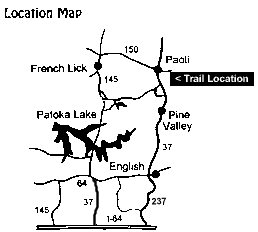
step back into the past. This 88 acre area is located just south of Paoli,
Indiana. Formerly known as Cox Woods, the tract is the last old growth
forest of its size known in Indiana. The site has been left virtually
undisturbed since before it was purchased by Joseph Cox in 1816.
Cox came
to Indiana from Tennessee and acquired 258 acres near what was to become
the town of Paoli. Cox loved trees and set aside 88 acres of his land
to save for future generations. His land stayed in the family and eventually
passed to another Joseph Cox who shared his grandfathers love of the stately
old trees. He resisted pressure to sell the large trees despite poverty
and debts.
The second
Joseph Cox died in 1940. His heirs quickly sold his property, including
the tract of old growth timber, to Wood-Mosaic Lumber Company of Louisville,
Kentucky for $23,000. When the sale was publicized in local papers, a
movement was started to save the unique tract from harvest. The Meridian
Club of Paoli convinced Wood-Mosaic to refrain from cutting the timber
for 90 days and to resell the tract at the purchase price. The community
then began a massive fund-raising effort.
The Forest
Service also initiated efforts to help save the old forest. The agency
was able to procure half the funds needed as long as the land would be
controlled by the Forest Service. The remaining money was quickly raised
with one day of grace and the land bought back from the lumber company.
Two conditions
were attached to the donations received from the community. First, no
trees on the 88 acres could ever be cut. Second, in tribute to the $5,900
donation from the Indiana Pioneer Mothers Club, the area would be named
the Indiana Pioneer Mothers Memorial Forest and a suitable memorial would
be built. A rock wall memorial was completed in 1951.
In 1944
the tract was designated a Research Natural Area by the Forest Service.
Along with a 165 acre buffer, the area is managed to protect its unique
qualities.
Today, because
of the determined commitment of many people, the Pioneer Mothers Memorial
Forest has been preserved. These great trees now stand as a monument to
the massive deciduous forests that covered Indiana 180 years ago.
Before the Cox Family Arrived...
Long before Joseph Cox arrived in 1816
this area was inhabited by Native Americans. One group is known as the
Oliver Phase people. These prehistoric people are believed to primarily
have lived in White River valleys between 1000 and 1500 A.D. They were
a farming culture who lived in small groups (up to about 100 individuals).
While most
Oliver Phase villages have been found along the White River, at least
one village was along Lick Creek in what is now the Pioneer Mothers Memorial
Forest.
Survey reports
noted the archaeological value of the Lick Creek site as early as 1876.
In the 1940's, Jesuit missionaries collected artifacts from the site and
did some excavation. Since a portion of the area had never been plowed
it was still apparent where the walled village had been.
A double-walled
post stockade designed for defense encircled the village. This stockade
enclosed over an acre of land. Excavations by the Glenn A. Black Laboratory
at Indiana University in 1993 and 1994 defined the walls and scope of
the village. Further study focused on identification of house sites and
a central plaza, and study of the daily life of these people.
Even though
vandalism and illegal digging have disturbed much of the area, the site
is eligible to the National Register of Historical Places.
Archaeological
sites hold clues to America's past. They are protected by Federal law.
If you discover such sites, leave them undisturbed and report your discoveries
to the Forest Service. Like the tall trees preserved for future generations
on the hillsides above the site, archaeological resources are shadows
of our past - a tie to the people and cultures that came before us.



|